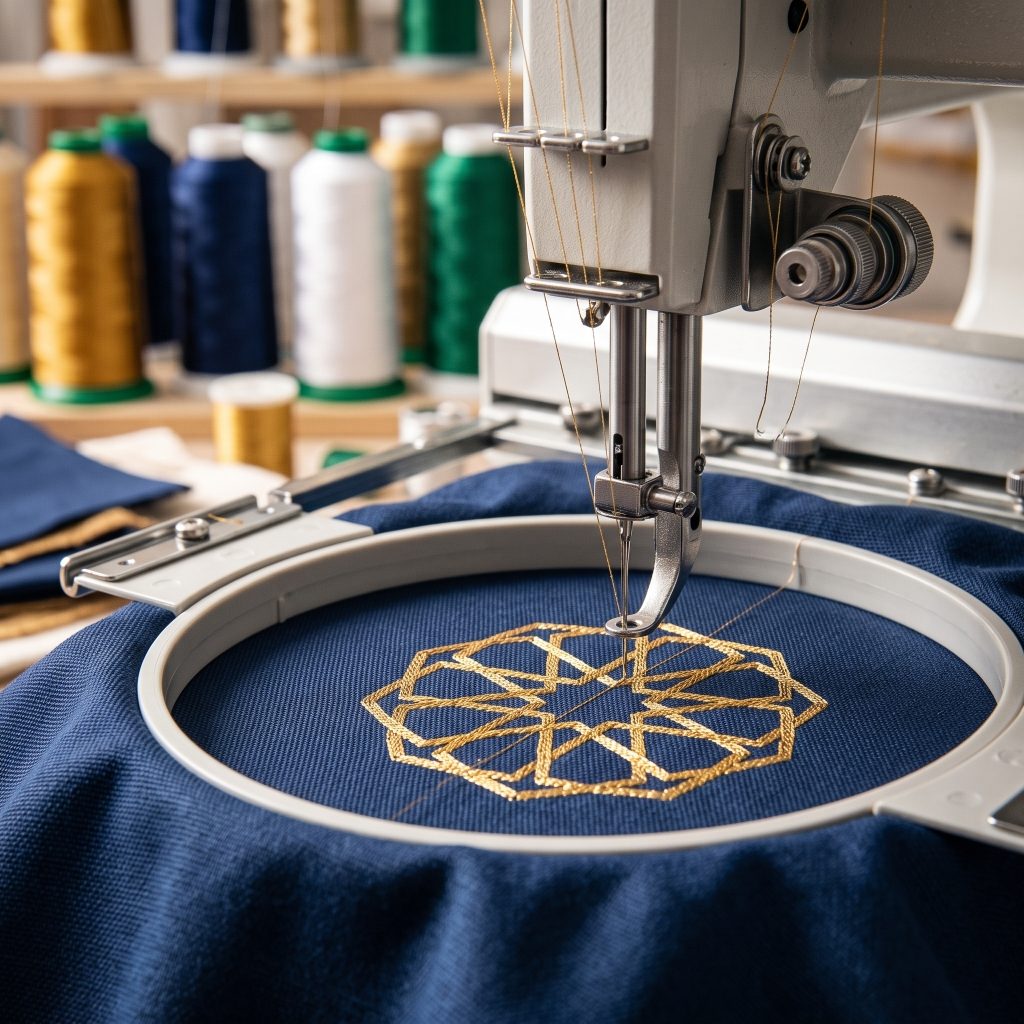
 A prayer cap can be simple in shape, yet the smallest details can give it remarkable character. A carefully stitched border, a geometric motif, or a subtle line of metallic thread can transform an otherwise plain piece of fabric into something expressive and distinctive.Embroidery has long been part of textile traditions across many parts of the Muslim world. Today, traditional ideas continue to inspire modern prayer caps, while contemporary machinery allows makers to achieve a level of consistency and detail that would be difficult to reproduce by hand at larger quantities. The result is a wide range of embroidered Islamic cap patterns, from understated borders to dense, highly detailed designs.
Where Tradition Meets Modern Stitching
Embroidery is essentially the art of decorating fabric with thread or other materials through stitching. Its history spans cultures and centuries, with techniques developing according to local materials, tools, and artistic traditions. You can explore a broader introduction to the craft in this overview of embroidery and its history.
Modern prayer caps often borrow the visual language of traditional needlework without attempting to reproduce one particular regional style. Geometric forms, repeating borders, floral influences, and symmetrical arrangements can all appear in contemporary designs. This makes embroidered caps interesting not only as religious headwear, but also as examples of textile craftsmanship.
High-Density Machine Embroidery
One of the most noticeable modern techniques is high-density machine stitching. Computer-controlled embroidery machines can place thousands of stitches into a relatively small area, creating patterns with sharp edges and strong visual definition.
This technique is especially useful for structured prayer caps because the embroidery can follow carefully measured shapes. A maker might use dense stitching to create a central geometric motif, a continuous band around the edge, or several coordinated sections across the crown.
High-density embroidery also creates texture. Depending on the thread and stitch direction, a pattern can appear almost raised from the surface of the fabric. When viewed closely, the different directions of the stitches can catch light differently, giving a seemingly simple design much more depth.
Geometric Motifs and Repetition
Geometry is particularly well suited to prayer cap embroidery. Repeating diamonds, stars, interlocking lines, stepped borders, and other symmetrical forms can be arranged around the circumference of a cap or concentrated on its upper panels.
Repetition is important because a prayer cap is a three-dimensional object. A pattern needs to remain visually balanced as it moves around the curved surface. Careful spacing helps the design feel intentional rather than crowded.
Many contemporary embroidered Islamic cap patterns use this principle to combine traditional visual balance with a clean, modern appearance. A narrow geometric border can provide detail without overwhelming the fabric, while a more elaborate arrangement can become the main visual feature of the cap.
Metallic Thread Accents
Metallic thread is another technique that can dramatically change the character of embroidery. Gold and silver-toned threads can be used as highlights rather than covering an entire design. This approach allows a maker to draw attention to particular lines, borders, or central motifs.
Metallic embroidery tends to respond strongly to light. A cap may look relatively restrained indoors, then reveal a subtle shimmer when the wearer moves under brighter lighting. Used carefully, this effect adds richness without requiring a complicated color palette.
Metallic thread can also be combined with ordinary embroidery thread. For example, a geometric pattern might be stitched primarily in navy or white, with metallic thread tracing selected portions of the design. The contrast gives the pattern definition while keeping the overall appearance cohesive.
Eyelet and Ventilation Stitching
Not every stitch on a prayer cap needs to be purely decorative. Eyelet-style stitching can introduce small openings into a design, allowing air to move through areas of the fabric while also creating an attractive patterned effect.
These details are particularly interesting on caps designed for regular wear in warm climates. Small perforated motifs can be incorporated into borders or repeated across selected sections. When combined with structured construction, the result can balance appearance, texture, and practical comfort.
The exact construction varies from one maker to another. Some caps use embroidery primarily as decoration, while others integrate stitching into the overall structure of the cap. Neither approach needs to be treated as more authentic than the other. Different regions and communities have developed their own approaches to textile decoration, and modern embroidery gives makers another way to build on those traditions.
Thread, Fabric, and Stitch Direction
The final appearance of embroidery depends on more than the pattern itself. Thread thickness, fabric texture, stitch density, and even the direction of individual stitches all affect how the finished cap looks and feels.
A fine thread can produce delicate outlines, while thicker thread creates stronger visual texture. Dense stitching can make a motif stand out, but excessive density may make a lightweight fabric feel stiff. Experienced makers therefore have to consider how the embroidery will interact with the base material.
Color matters too. White embroidery on a dark cap can create a crisp, traditional appearance, while navy, emerald, burgundy, gold, or other shades can give the same basic motif a completely different character. There is no single correct palette. Regional preferences, personal taste, and the intended occasion can all influence the choice.
Appreciating the Craft
There is something satisfying about looking closely at a well-made embroidered prayer cap. From a distance, the design may appear to be a simple border or repeating pattern. Up close, the individual stitches reveal how much planning goes into maintaining symmetry, spacing, and texture across the curved surface.
It is also worth appreciating that Muslim communities have never had just one approach to headwear. Styles and textile traditions differ across regions, cultures, and communities. These differences can be appreciated without assigning one particular embroidery tradition greater religious significance than another. Across the major schools of Islamic jurisprudence, personal and regional differences in clothing and ornamentation can coexist with the shared purpose of modest and respectful dress.
If you enjoy wearing detailed needlework and want to explore a variety of contemporary styles, you can take a look at the embroidered kufi hats collection. The goal is not simply to find the most elaborate design, but to notice the different ways fabric, thread, pattern, and construction come together.
Whether the embroidery is bold and intricate or quiet and understated, good needlework rewards a closer look. A prayer cap may be a small piece of clothing, but the stitching across its surface can carry an appreciation for craftsmanship, regional textile traditions, and the beauty of carefully made things.

Comments