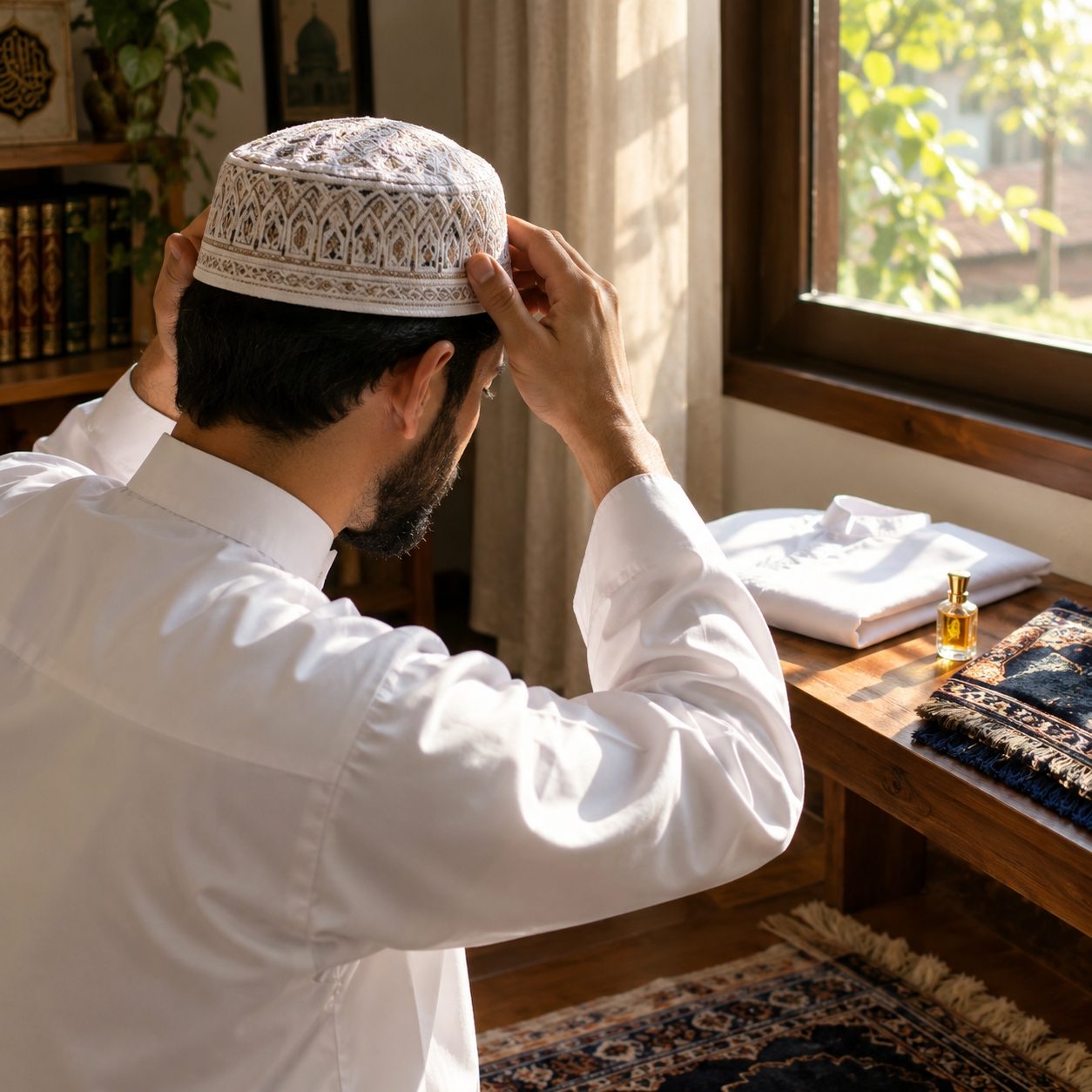
Friday has a way of changing the pace of the week. There is the familiar preparation for Jumu’ah: taking a shower or ghusl, putting on clean clothes, applying a little perfume, and making our way to the masjid with a different sense of purpose.
For many Muslim men, there is one more part of getting ready: choosing a kufi, turban, or another traditional headcovering. For some, it is simply what they have always worn to the masjid. For others, it is connected to family, culture, or a particular tradition of Islamic dress.
So what should we know about Friday prayer headcovering etiquette? Is a kufi required? Does wearing one have a special status on Friday? And how should we think about the many different styles seen in Muslim communities around the world?
Is a Headcovering Required for Jumu’ah?
A headcovering is not a universal requirement for the validity of a man’s Jumu’ah prayer. The major schools of Islamic jurisprudence have their own discussions concerning prayer clothing and modesty, but there is no single type of cap that every Muslim man is required to wear for Friday prayer.
That distinction is useful because it allows us to appreciate headcovering traditions without turning a cultural practice into a rule that applies to everyone.
In one mosque, you might see simple white kufis. In another, embroidered caps, turbans, ghutras, or other regional styles may be more common. Some men will not cover their heads at all. All of these practices can be understood within the broader diversity of Muslim communities.
The Sunnah of Preparing for Friday
While a particular headcovering is not required, the Sunnah does give us plenty to think about when it comes to preparing for Jumu’ah.
The Prophet Muhammad ﷺ encouraged Muslims to take care with their appearance before attending the Friday gathering. Narrations mention bathing, wearing good clothing, using perfume, and going to the congregational prayer with consideration for others.
One narration in Sunan Abi Dawud describes Friday preparation in terms of bathing, wearing one’s best clothes, applying perfume when available, and attending the prayer while avoiding behavior that might disturb other people. Sunan Abi Dawud 343 records this narration.
Another narration also mentions bathing and wearing good clothing and perfume for Friday. Sunan Abi Dawud 347 provides this additional report.
There is something quite practical about this guidance. We are not only preparing ourselves for worship. We are preparing to spend time closely alongside other people.
Clean Clothes, Good Manners, and Consideration
The Qur’an gives a beautiful general principle for entering the masjid:
“O children of Adam, take your adornment at every masjid…”
The verse reminds us to approach places of worship appropriately and with dignity. Read Qur’an 7:31 in full.
The Friday Sunnah builds on this spirit. Cleanliness, fresh clothing, personal grooming, and a pleasant scent all contribute to the atmosphere of the gathering.
There is even a narration that gives some historical context for the emphasis on bathing before Friday. The Companions sometimes worked in conditions that caused them to perspire, and the guidance was connected with avoiding unpleasant smells when people gathered in the mosque. Sunan Abi Dawud 353 records this account.
It is a good reminder that preparing for Jumu’ah is not about appearance for appearance’s sake. It is also about being considerate toward everyone who will share the prayer space with us.
Where Does the Kufi Come In?
This is where the kufi can become a meaningful part of someone’s Friday routine.
A man might keep a favorite embroidered kufi specifically for Jumu’ah. Another might wear the same simple cap he uses throughout the week. Someone else may have inherited a traditional style from his father or grandfather. These personal connections can make an ordinary piece of clothing feel quite special.
Across the Muslim world, headwear has also developed in many beautiful directions. Embroidery, weaving, shape, fabric, and color can all reflect a region’s history and craftsmanship. An African kufi does not need to look like an Omani kumma, and neither needs to resemble a South Asian prayer cap. Each tradition has its own character.
That variety is worth appreciating rather than trying to reduce Muslim dress to a single style.
If an embroidered kufi is part of your own Friday wardrobe, you can browse a selection of embroidered kufi hats for something simple and suitable for the masjid.
A Simple Friday Routine
For someone wanting to make Friday preparation more intentional, it can be quite simple:
- Take care of personal cleanliness and perform ghusl where appropriate.
- Choose clean, respectable clothing.
- Use perfume or ‘atar if desired and appropriate.
- Wear a kufi or other headcovering if it is part of your personal or cultural practice.
- Give yourself enough time to reach the masjid without rushing.
- Once there, be mindful of those around you and listen attentively to the khutbah.
None of this needs to feel complicated. The beauty of the Friday routine is that small acts of preparation can help us turn our attention away from the busyness of the week and toward worship.
Different Traditions, One Friday Gathering
One of the nicest things about Jumu’ah is seeing the variety of people who gather for it.
You may see a man in a beautifully embroidered kufi standing beside someone wearing a turban. Someone may arrive in a thobe, another in a batik shirt, and another straight from work in simple, clean clothing. One person may cover his head, while another does not.
There is no need for everyone to look the same.
What brings us together is the prayer itself, the khutbah, the remembrance of Allah, and the shared experience of gathering as a community. Clothing can express culture and personal tradition, but it should not become a measure by which we judge another person’s faith.
A Small Tradition With a Bigger Meaning
For many men, putting on a kufi before heading to the masjid is simply part of Friday. It may take only a few seconds, but it can mark a change in mindset: the workweek is being set aside, and it is time for Jumu’ah.
Whether that means an embroidered kufi, a turban, a regional headcovering, or simply clean hair and good clothing, the important thing is to approach Friday with care and respect.
That may be the most useful way to think about Friday prayer headcovering etiquette. There is room for tradition without making tradition into a requirement. There is room for cultural variety without losing the shared character of Jumu’ah.
And there is something beautiful about taking a little extra care before standing among the community to remember Allah.
For more background on Friday prayer and Jumu’ah, see this overview of Jumu’ah and Friday prayer.

Comments