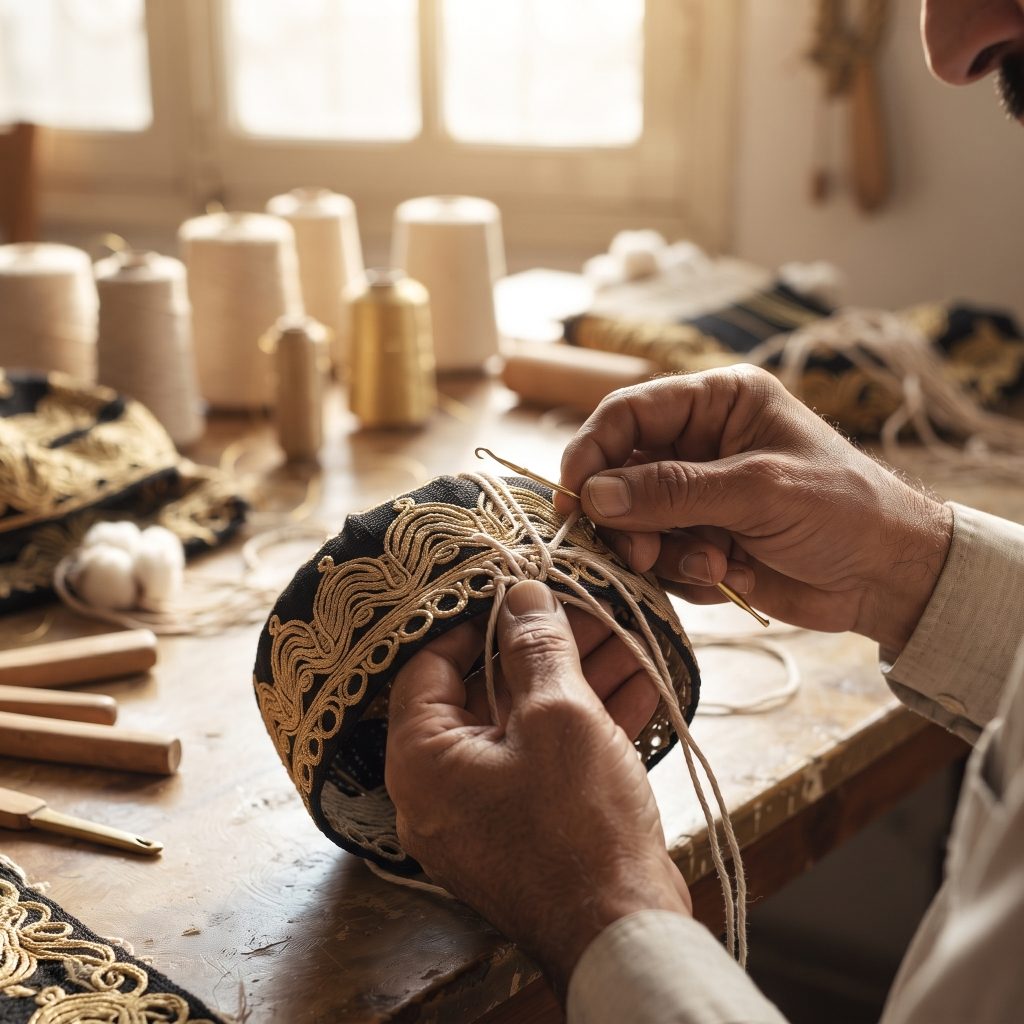
There is something special about a kufi that has clearly been made by hand. Look closely and you can often see the small details that give it character: the texture of the material, the way the pattern comes together, and the subtle variations that make the finished piece feel unique.
Macramé brings that handmade character to life through something wonderfully simple: knots. In macrame knotting kufi craft, ordinary cords or threads are carefully tied and arranged to create a cap that is textured, structured, and distinctive.
What Makes Macramé Different?
Macramé is a textile technique based on knotting rather than traditional weaving or knitting. Different knots can be repeated and combined to create everything from simple patterns to detailed geometric designs. The technique has been used across different cultures and for many kinds of practical and decorative items.
You can read more about the history and techniques of macramé and its knotting traditions if you are curious about where this craft comes from.
For a kufi, the technique offers an especially interesting result. Instead of a completely flat surface, the knots create depth. Light catches the raised threads, the spaces between them create small shadows, and the entire cap can take on a rich woven appearance.
It is a good example of how a simple material can become something much more interesting when someone takes the time to work with it carefully.
Every Knot Becomes Part of the Design
One of the things we enjoy about hand-knotted kufis is that the pattern is not simply printed onto the fabric. The pattern is built into the material itself.
A row of knots can form a border. Repeated knots can create a geometric pattern. Changes in direction can add visual movement. A tighter arrangement can give the kufi a firmer, more structured appearance, while a different knotting pattern can create a softer and more open texture.
None of this has to be overly complicated. In fact, some of the most appealing designs are quite simple. The beauty comes from the consistency of the work and the texture created by the knots.
And when you pick up a handmade kufi, you can feel that difference as well as see it.
The Patience Behind a Hand-Knotted Kufi
Macramé looks simple when you watch someone who knows what they are doing. The hands move naturally, one knot follows another, and the pattern gradually takes shape. But getting that consistency takes practice.
The maker has to pay attention to tension, spacing, direction, and the overall shape of the cap. Pull a knot too tightly and the texture can change. Leave one too loose and the pattern may not sit as neatly. As the work progresses, the maker has to keep an eye on the shape so that the finished kufi remains comfortable and well structured.
That patience is part of the appeal.
When you see a finished macramé kufi, it can be easy to notice only the overall design. Looking closer gives you a different appreciation. Each little section represents another movement of the hands, another knot, and another small step toward the finished piece.
Why Handmade Details Matter
There is a certain charm to something that has been made rather than simply manufactured.
A handmade kufi does not necessarily need to be perfectly identical to another one. Small differences in the texture or pattern can be part of its character. They remind us that a person was involved in making it.
This is especially noticeable with macramé because the construction is so visible. You can actually see the work. The knots are not hidden inside the finished product. They are the finished product.
That makes macramé an interesting fit for kufi production. The craftsmanship becomes part of the appearance rather than something hidden behind it.
A Craft That Fits Many Muslim Traditions
Kufis have never had just one appearance. Muslim communities around the world have developed their own styles of caps and other forms of headwear, influenced by local materials, climate, culture, and tradition.
That variety is something worth celebrating. A beautifully embroidered cap from one part of the world, a knitted kufi from another, and a hand-knotted macramé kufi can all have their own character without needing to look alike.
Macramé simply gives makers another way to explore texture and form while creating something practical for everyday Muslim dress.
It also shows how traditional crafts can continue to find their place in modern clothing. The technique may be old, but there is nothing old-fashioned about appreciating good workmanship.
Beauty, Clothing, and Taqwa
Islam gives us a balanced way of thinking about clothing. We can appreciate beauty and craftsmanship while remembering that outward appearance is not the measure of a person’s faith.
Allah says in the Qur’an:
“O children of Adam, We have bestowed upon you clothing to conceal your private parts and as adornment. But the clothing of righteousness, that is best.”
Qur’an 7:26
The verse acknowledges both purposes of clothing: covering and adornment, while directing our attention toward something deeper, the clothing of righteousness. Read Qur’an 7:26 in full.
That makes a beautiful kufi worth appreciating for what it is: a well-made piece of clothing that can bring together usefulness, personal style, culture, and craftsmanship. The knots may make the kufi beautiful, but they are never a substitute for the qualities that matter most within a person.
What to Look For in a Macramé Kufi
If you are drawn to macramé kufis, take a moment to look beyond the overall shape. The details are where the craft really becomes interesting.
- Consistent knotting: Look for a pattern that feels balanced and carefully made.
- Good structure: The kufi should hold its shape without looking stiff or uncomfortable.
- Interesting texture: Notice how the knots catch light and create depth across the surface.
- Comfortable material: A beautiful cap still needs to feel good when worn.
- Clean finishing: Edges and joins should look intentional and secure.
The right kufi is ultimately a matter of personal taste. Some people prefer a more substantial woven texture, while others enjoy something lighter and simpler. What matters is finding a piece that you genuinely enjoy wearing.
When Simple Knots Become Something Special
Perhaps that is what makes macramé so enjoyable. The individual knot is incredibly simple. But repeat it carefully, arrange it thoughtfully, and give it shape, and suddenly those small knots become something much more than they were on their own.
The same can be said of a well-made kufi. It may be a relatively small piece of clothing, but there can be a surprising amount of thought and craftsmanship behind it.
If you appreciate hand-woven craftsmanship and the distinctive texture of knotted designs, you can explore the collection of macramé kufi hats and see how this traditional knotting approach is used in contemporary kufi styles.
Whether you wear a kufi every day, mainly for salah, or simply appreciate the craft behind different forms of Muslim headwear, macramé offers something worth looking at a little more closely.
Sometimes, the beauty is right there in the details: one knot, then another, and another, until a simple thread becomes a kufi.

Comments