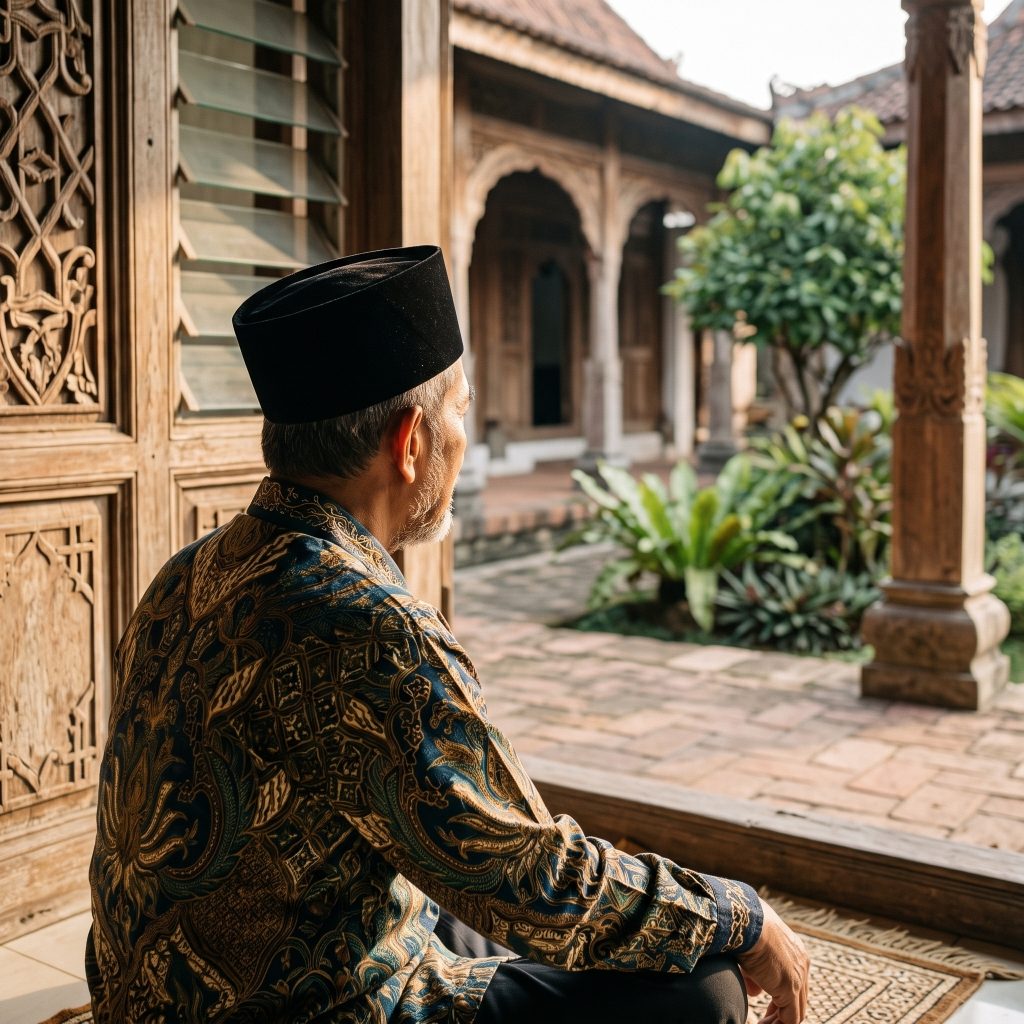
A Tradition Shaped by the Malay Archipelago
The history of the Songkok reflects the many cultural influences that have shaped Maritime Southeast Asia. The region has long been connected by trade, migration, scholarship, and the spread of Islam, with communities sharing ideas about clothing and customs along the way.
The exact origins of the modern Songkok are difficult to trace to a single source. Similar styles of headwear developed and were adapted in different parts of the Muslim world, while local makers in Southeast Asia developed their own distinctive forms. By the late 19th and early 20th centuries, the black velvet Songkok had become increasingly familiar as part of Malay and Indonesian dress.
In Indonesia, the Peci also became closely associated with national identity. It was worn by prominent figures including Sukarno, helping establish the black cap as a familiar part of formal Indonesian attire beyond religious settings.
What Makes a Songkok?
Unlike a soft knitted prayer cap, a traditional Songkok has a structured form that gives it its distinctive appearance. While construction varies between makers and regions, several features are commonly associated with the classic style.
- Structured shape: An internal foundation gives the cap its firm sides and characteristic oval or slightly tapered profile.
- Velvet covering: Black velvet is one of the most recognizable materials, valued for its smooth appearance and subtle sheen.
- Careful fitting: A well-made Songkok should sit securely on the head while remaining comfortable enough for extended wear.
- Traditional craftsmanship: Skilled makers pay attention to the shape, stitching, lining, and finishing so the cap keeps its form over time.
Although the classic black version remains the most recognizable, Songkoks can also be found in different colors, materials, patterns, and finishes depending on the region and occasion.
When Is the Songkok Worn?
The Songkok can be both religious and cultural headwear. How it is worn often depends on local customs, the occasion, and personal preference.
- Prayer and religious gatherings: Many Muslim men wear a Songkok or Peci when attending the mosque, Jumu’ah, religious gatherings, or Quran recitation.
- Eid and celebrations: The cap is commonly paired with traditional clothing during Eid al-Fitr, Eid al-Adha, weddings, and family celebrations.
- Formal occasions: In Indonesia and Malaysia, the Songkok is also associated with ceremonies, official events, graduations, and other occasions where traditional formal dress is appropriate.
- Everyday traditional dress: For many people, there is no special occasion required. A simple Peci can be worn as part of everyday traditional or modest clothing.
Its versatility is part of what has allowed the Songkok to remain familiar across generations. It can accompany a Baju Melayu, batik shirt, traditional Indonesian clothing, or other modest attire without looking out of place.
For those interested in adding this classic piece of Southeast Asian headwear to their wardrobe, explore our Songkok and Peci collection for traditional styles designed with comfort and everyday wear in mind.
Caring for a Velvet Peci
A structured velvet Peci is relatively simple to maintain. The most important thing is to protect its shape and keep the velvet clean.
When it is not being worn, store the cap somewhere that will not place pressure on its sides or top. A suitable box or shelf can help prevent the structure from becoming flattened. For light dust, gently brush the velvet with a soft clothes brush, following the direction of the fabric rather than rubbing it aggressively.
With basic care, a well-made Songkok can remain part of a wardrobe for many years, becoming familiar through the occasions and memories associated with it.
A Lasting Part of Southeast Asian Dress
The Songkok and Peci may have a simple design, but their place in Southeast Asian culture is anything but simple. They reflect the region’s Islamic heritage, local craftsmanship, traditional clothing, and changing sense of identity.
Whether worn for Jumu’ah, Eid, a wedding, a formal ceremony, or an ordinary day, the Songkok remains a recognizable and enduring part of the region’s sartorial heritage.

Comments