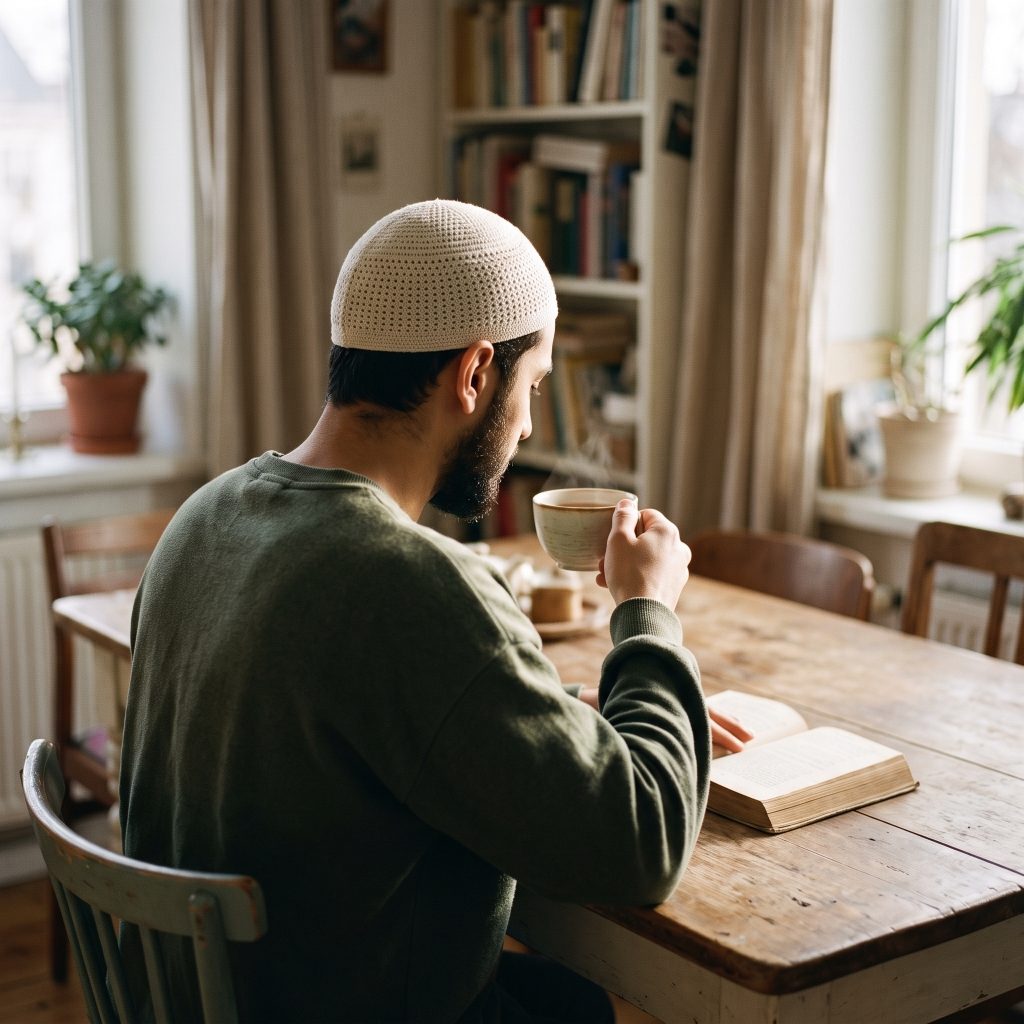
Some mornings begin in a hurry. The alarm goes off, the kettle is switched on, messages are already waiting, and there is a long list of things to get through before the day has properly started.
And then there are quieter mornings.
You sit for a few minutes with a cup of tea. You read something. The house is still. You get dressed without thinking too much about it, perhaps reaching for a familiar cap before heading out.
There is nothing particularly remarkable about the moment. Yet these small routines are often where our sense of identity quietly lives.
More Than Getting Dressed
Muslims have always paid attention to the way they present themselves. Not because Islam asks us to be preoccupied with appearance, but because the outward and inward parts of life are not completely separate.
The Qur’an reminds us that clothing serves both a practical and an aesthetic purpose:
“O children of Adam, We have bestowed upon you clothing to conceal your private parts and as adornment. But the clothing of righteousness, that is best.”
Qur’an 7:26
That last part is easy to overlook. We can spend plenty of time thinking about what looks good, what feels comfortable, or what is appropriate for an occasion. The Qur’an brings our attention back to something that cannot be seen as easily: libas at-taqwa, the clothing of righteousness.
In other words, modesty is not simply a matter of fabric. It is also a matter of how we conduct ourselves.
A Cap Can Be Something Very Ordinary
There is a tendency to make religious clothing sound more complicated than it really is.
For many Muslim men, a cap is simply part of getting dressed. It might be something picked up from a father or grandfather. It might be associated with going to the masjid. It might be a familiar part of local dress. Or perhaps it is simply comfortable and feels right.
Across Muslim communities, there are countless versions of this simple idea. A takke in Türkiye, a topi in South Asia, a kufi in parts of Africa and the Arab world, or other traditional forms of headwear all have their own histories and associations.
These differences are worth enjoying rather than flattening into one idea of what Muslim clothing is supposed to look like.
The Sunnah of the Prophet Muhammad ﷺ gives Muslims an example for many aspects of life, but it does not mean that every Muslim community must dress identically. Culture, climate, local customs, and personal circumstances have always played a role in how Muslims dress.
Not Every Good Tradition Is an Obligation
This is an important distinction when talking about headwear.
Muslim men may choose to wear a cap as part of modest dress, custom, respect, or personal devotion. Many communities have a long tradition of doing so. But wearing a particular style of cap should not be turned into a universal test of religious commitment.
A man who wears a cap is not necessarily more pious than one who does not. Nor does someone who does not wear one need to be regarded as neglecting the Sunnah.
There is something healthier in allowing a good custom to remain a good custom.
For one person, putting on a cap before leaving home may feel like part of his Muslim identity. For another, it may be something he wears mainly for prayer or religious gatherings. Someone else may prefer not to wear one at all. We can understand these differences without making them into a competition.
When Clothing Connects Us to People
Clothing can also carry memories.
A particular style of cap may remind someone of his childhood. Another may associate it with his local masjid, a teacher, an elder in the family, or a special Ramadan gathering. Sometimes we keep wearing something simply because we remember seeing it worn by people we respected.
That kind of connection is difficult to put into a rulebook.
It is part of the living tradition of Muslim communities. The Sunnah is not only something we encounter in books. It has also shaped homes, gatherings, manners, clothing, hospitality, and countless small habits passed from one generation to another.
Some of those habits are religious practices. Some are customs. Often, the two sit comfortably alongside one another without needing to be separated at every moment.
Modesty Does Not Have to Feel Formal
There is also a difference between dressing modestly and dressing ceremonially.
Most of our lives are not spent at Eid, in the masjid, or at a formal religious gathering. We are answering emails, buying groceries, working, driving, visiting family, sitting at home, and doing all the ordinary things that make up a week.
Modest clothing belongs there too.
It can be simple. It can be comfortable. It can suit the weather and the place. It does not have to announce anything about us.
For someone who enjoys wearing a cap, a simple takke can fit naturally into that kind of wardrobe. If you are looking for something uncomplicated for everyday use, you can browse a selection of Turkish-style takke caps.
The point is not to turn a cap into a symbol that needs to be explained. Sometimes it is just something you put on before walking out the door.
The Quiet Side of Sunnah
Perhaps that is what makes everyday Sunnah so easy to appreciate.
Not everything has to feel dramatic. Some practices become meaningful precisely because they settle into our lives so naturally that we hardly notice them anymore.
We dress with dignity. We keep ourselves clean. We try to speak well to people. We remember Allah. We make time for prayer. We show respect to our elders. We try to leave a little less harm behind us than we found.
A piece of clothing can sit within that larger picture without becoming the whole picture.
For some men, a familiar cap is one small part of that daily rhythm. It may carry culture, memory, comfort, or simply a sense of being properly dressed. For others, modesty will look different.
What matters most is what remains when the clothing is taken off: humility, good character, and an awareness of Allah.
That is the part of modesty worth carrying with us wherever we go.

Comments