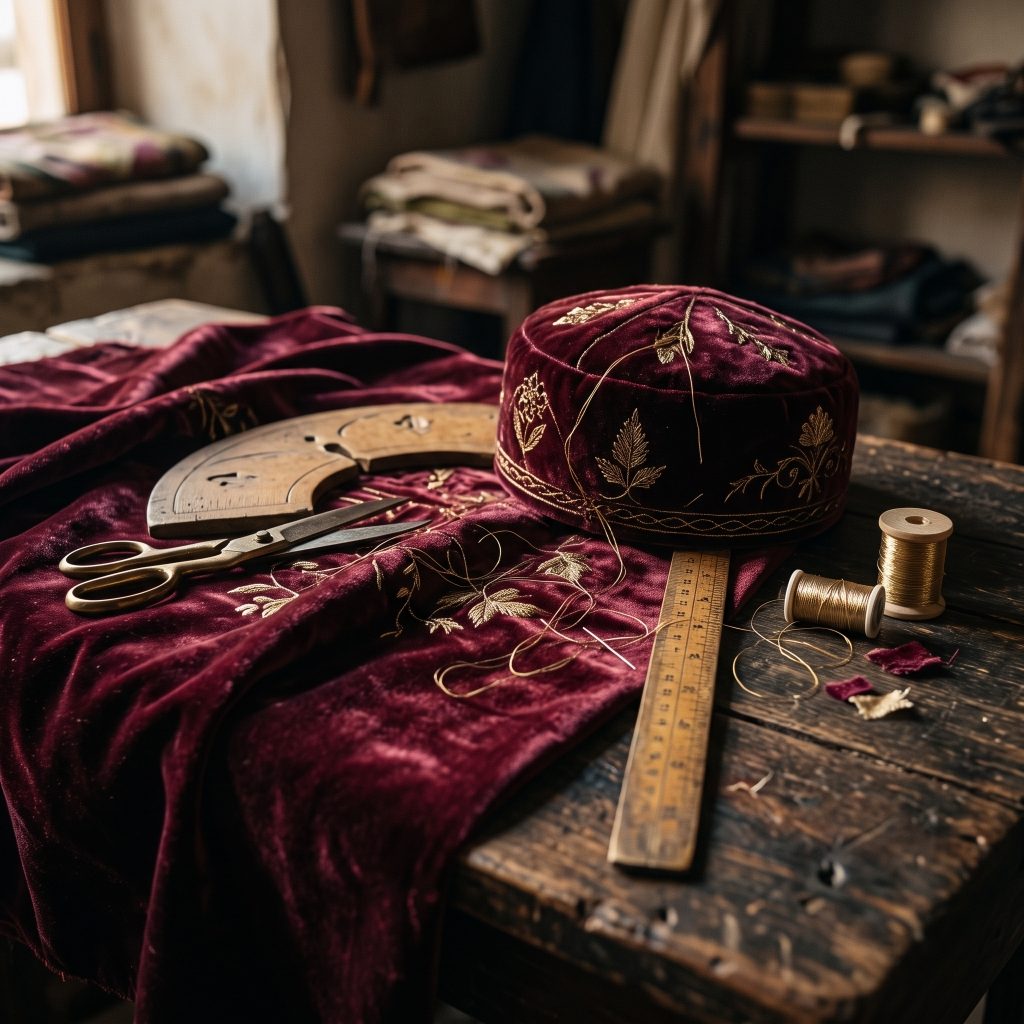
The Texture and History of Velvet Headwear
Some fabrics are remembered for their color. Others are remembered for the way they feel in the hand. Velvet has always belonged to the second group.
There is something immediately distinctive about it. Run your fingers across a piece of velvet and the surface seems to change beneath them. Brush the pile one way and it becomes darker. Turn it the other way and the color opens up again. Under warm light, the fabric can look almost luminous.
That quality has made velvet fascinating for centuries. Long before it found its way into modern kufis and other forms of headwear, it was part of a much larger story of silk, craftsmanship, trade, and the appreciation of beautiful textiles across the Muslim world.
A Fabric Made to Be Felt
Velvet is not simply a smooth woven cloth. Its distinctive surface comes from a raised pile, created through a specialized weaving process. Those tiny fibers are what give the fabric its softness and the deep, shifting appearance that makes it so recognizable.
Historically, producing fine velvet required considerable skill. Silk was often used, and the weaving itself could be complicated, particularly when patterns, metallic threads, or multiple colors were involved. The result was a fabric that could be expensive and time-consuming to produce.
You can learn more about the material itself in this overview of velvet and its history. But the technical process only tells part of the story. What is more interesting is what people did with this remarkable cloth once it existed.
Velvet Along the Old Textile Routes
For centuries, textiles moved across the same roads and waterways as spices, books, ceramics, metals, and other valuable goods. Cloth was one of the great travelers of the premodern world.
Bursa, in present-day Türkiye, became one of the important centers of silk production under the Ottomans. Its workshops produced luxurious fabrics that were sought after both within the empire and beyond it. Some of the surviving Bursa velvets are remarkably beautiful, with dense patterns of flowers and leaves woven into rich grounds of red, green, gold, and other deep colors.
What makes these old textiles particularly interesting is how much they reveal about the people who made and wore them. A fabric could carry the style of a particular city, the skill of a particular workshop, and influences that had traveled from somewhere much farther away.
Velvet itself was not confined to one culture. European workshops produced their own highly regarded velvets, while Ottoman markets received fabrics from different parts of the Mediterranean and beyond. Designs and techniques moved back and forth, changing along the way.
It is easy to forget how connected the textile world already was hundreds of years ago. The Metropolitan Museum of Art’s collection includes an embroidered velvet cap from its Islamic Art collection, a small but tangible example of how this luxurious fabric found its way into Muslim headwear.
South Asia and the Love of Fine Cloth
The story becomes just as rich when we look toward South Asia.
Mughal courts developed an extraordinary appreciation for textiles. Royal workshops brought together weavers, dyers, embroiderers, and other craftspeople whose work could be extraordinarily intricate. Silk, brocade, velvet, cotton, and other fabrics all had their place, depending on the garment, occasion, and region.
But fine clothing was not simply about showing wealth. Fabric had a sensory quality that mattered. Its weight, softness, warmth, color, and movement all contributed to the experience of wearing it.
That is something worth remembering when looking at historical clothing. A textile in a museum case can look beautiful, but the person who originally wore it experienced something very different. They felt its weight on the body. They noticed its softness. They saw how the color changed in sunlight or candlelight. They knew its texture without having to think about it.
When Velvet Becomes a Kufi
Perhaps this is part of the reason velvet works so naturally as a material for headwear.
A kufi does not need to be complicated. Its shape is often simple and familiar. But changing the fabric can change the entire feeling of the piece.
Velvet gives a kufi a certain depth. The color appears fuller, the surface has movement, and even a relatively understated design can feel suited to a special occasion. Deep burgundy, forest green, navy, black, and other rich shades can look particularly striking because of the way the pile catches the light.
There is no single historical or religious style that a velvet kufi has to represent, either. Muslim communities have always had their own regional traditions of dress and headwear. What one community considers formal, another may regard as everyday clothing. What matters is that these traditions can coexist, each with its own history and character.
Beauty Without Excess
There is also a quiet lesson in the way fine textiles have been appreciated in Muslim cultures.
Islamic traditions have never required people to make themselves plain simply for the sake of being plain. There has long been room for cleanliness, dignity, good presentation, and beautiful clothing, particularly when gathering with others for important occasions.
At the same time, beauty does not have to become extravagance. A beautifully made piece can be quite simple. Sometimes the quality of the fabric is enough.
That balance is one of the things I find appealing about velvet headwear today. The richness comes from the material itself. There does not need to be a complicated pattern or excessive ornamentation. The texture does much of the work.
The Part You Notice Up Close
From across a room, velvet may simply look like a deep, rich color. It is only when you get closer that the interesting details begin to appear.
You can see the direction of the pile. You can watch a fold become lighter as it catches the light. You can feel the difference between moving your hand with the pile and against it. Even the smallest movement can change the appearance of the fabric.
That tactile quality is easy to overlook in photographs, but it is really the heart of velvet.
It also gives a modern kufi a connection to something much older. The hat itself may have been made recently, but the appreciation for rich, carefully crafted cloth belongs to a much longer tradition.
A Small Piece of a Much Bigger Story
The history of the velvet fabric skull cap is not really a history of one particular kind of hat. It is a small part of the much larger history of textiles in Muslim societies.
It is a story about artisans who understood how to work with difficult materials, merchants who carried cloth across enormous distances, courts that valued exceptional craftsmanship, and ordinary people who simply appreciated the pleasure of wearing something well made.
That history is still visible today whenever someone chooses a velvet kufi for a gathering, a special meal, Friday prayer, Eid, or simply because they enjoy the way it feels.
Sometimes the connection between the present and the past is not found in an old manuscript or an ancient building. Sometimes it is as simple as a piece of cloth beneath your fingertips.
If you enjoy that particular softness and depth, you can take a look at the velvet kufi collection and see how the character of the fabric comes through in contemporary styles.

Comments