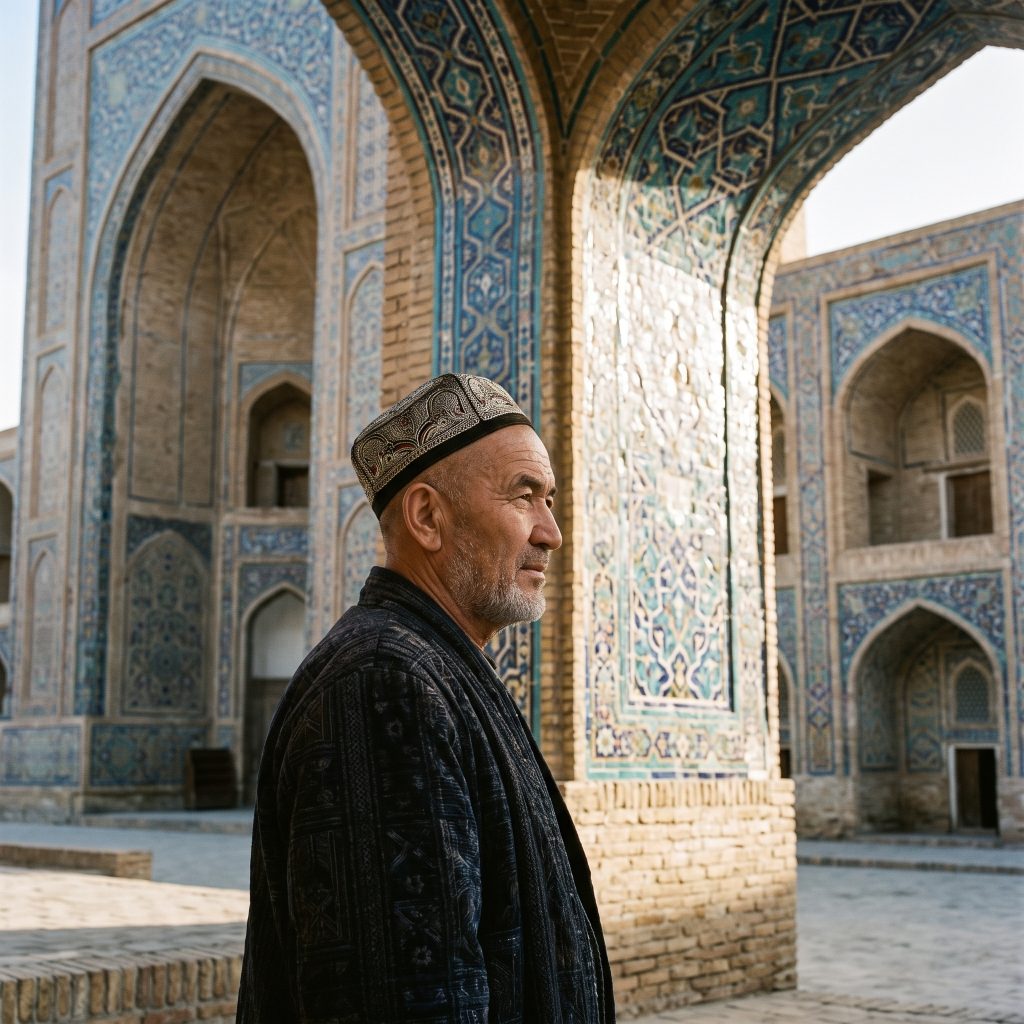
There are places where history seems to remain close to the surface. Bukhara is one of them. Walk through its old streets and the story is not difficult to imagine: merchants arriving after long journeys across the Silk Road, scholars making their way toward a madrasa, craftsmen opening their workshops for the day, and travelers pausing beneath the shade of ancient buildings.
In that setting, clothing was more than something practical to wear. It became part of the visual character of the city. Robes, belts, turbans, and caps all carried traces of regional taste and craftsmanship. Among these traditions, the structured Bukhara-style cap has a distinctive presence, connecting everyday dress with the rich cultural world of Central Asia.
A City at the Heart of the Silk Road
Bukhara developed for centuries as a center of commerce, scholarship, religion, and craftsmanship. Its position in Central Asia brought people and ideas together from remarkably distant parts of the world. Goods passed through its markets, while knowledge traveled through its madrasas and religious institutions.
For a closer look at the city’s long history and its importance in the region, the history and cultural heritage of Bukhara offer a useful starting point.
The city’s architecture still reflects that heritage. Brick walls, carved wooden details, monumental gateways, and brilliant tilework create an atmosphere that feels unmistakably Central Asian. The famous blue and turquoise mosaics of Bukhara and neighboring Samarqand are especially striking, with geometric patterns that seem to echo the careful repetition found in traditional textile and embroidery work.
The Bukhara Cap
Traditional Bukhara-style headwear belongs to a broader family of Central Asian caps, but its character is easy to recognize. Rather than being a soft, loosely shaped covering, the design has a firm structure that gives it a defined silhouette. Decorative embroidery can add another layer of character, with carefully worked patterns covering the surface in a way that reflects the region’s long appreciation for detailed craftsmanship.
This structure is part of what makes Bukhara style Central Asian caps so visually distinctive. They have presence without needing to be elaborate. The shape sits naturally above the head, while the embroidery gives the otherwise simple form a sense of depth and identity.
It is worth remembering that traditional dress rarely belongs to a single moment in history. Styles develop gradually. Materials change, craftsmen introduce new details, and communities adapt clothing to their own customs. A traditional cap therefore tells a story not only about a particular city, but also about the people who made, wore, and passed down these forms of dress.
Craftsmanship in the Details
One of the most appealing things about Central Asian headwear is the relationship between structure and decoration. The cap itself provides a strong, almost architectural foundation. Embroidery then works across that foundation with lines, shapes, and repeated motifs.
That connection to architecture is especially fitting in Bukhara. The same visual language of repetition and geometry can be found throughout the city’s historic buildings. Tile patterns frame doorways and arches. Decorative borders guide the eye across walls. Small details become part of something much larger.
A carefully embroidered cap can create a similar impression. From a distance, its overall form is simple. As you look closer, the workmanship becomes more apparent. The stitching, texture, and arrangement of the pattern reveal the patience behind the finished piece.
Headwear in the World of Scholars and Merchants
Central Asian cities such as Bukhara and Samarqand were not simply trading stops. They were places of learning. Scholars, students, merchants, artisans, travelers, and religious figures shared the same urban spaces, and clothing naturally became part of that environment.
Traditional headwear could convey a sense of dignity and readiness for public life without needing to make a dramatic statement. In a madrasa courtyard, a marketplace, or a gathering with family and friends, a well-made cap belonged comfortably within the broader tradition of modest and respectful dress.
There is something meaningful about that continuity today. Wearing a traditional Central Asian style does not require pretending to live in another century. It can simply be an appreciation for the craftsmanship and cultural memory carried by an old design.
From Bukhara to the Modern Wardrobe
The most interesting traditional clothing is often clothing that can still find a place in everyday life. A Bukhara-style cap can be worn with traditional garments, but its structured shape can also sit naturally alongside a simple shirt, tunic, or contemporary Muslim wardrobe.
That versatility helps explain why traditional headwear continues to appeal across generations. The design has enough historical character to feel special, while its clean shape keeps it from feeling like a costume.
If you appreciate the firm structure, traditional character, and rich embroidery associated with Central Asian headwear, you can explore the Bukhara-style hats collection for contemporary pieces inspired by this heritage.
Keeping a Cultural Tradition Close
Perhaps the greatest charm of Bukhara-style headwear is that it invites us to look beyond the object itself. A cap may be small, but the history surrounding it is not. It points toward the workshops of Central Asian craftsmen, the busy roads of the Silk Road, the courtyards of historic madrasas, and the remarkable architectural traditions of cities that became centers of learning and exchange.
When traditional clothing survives into the present, it carries more than an old shape. It carries memory. Wearing it can be a quiet way of appreciating the people, places, and craftsmanship that shaped it.
And perhaps that is what makes the Bukhara design so enduring. Its story is not locked inside a museum. The structured form, careful embroidery, and unmistakable Central Asian character can still be part of how we dress today, allowing a small piece of Silk Road heritage to continue its journey.

Comments