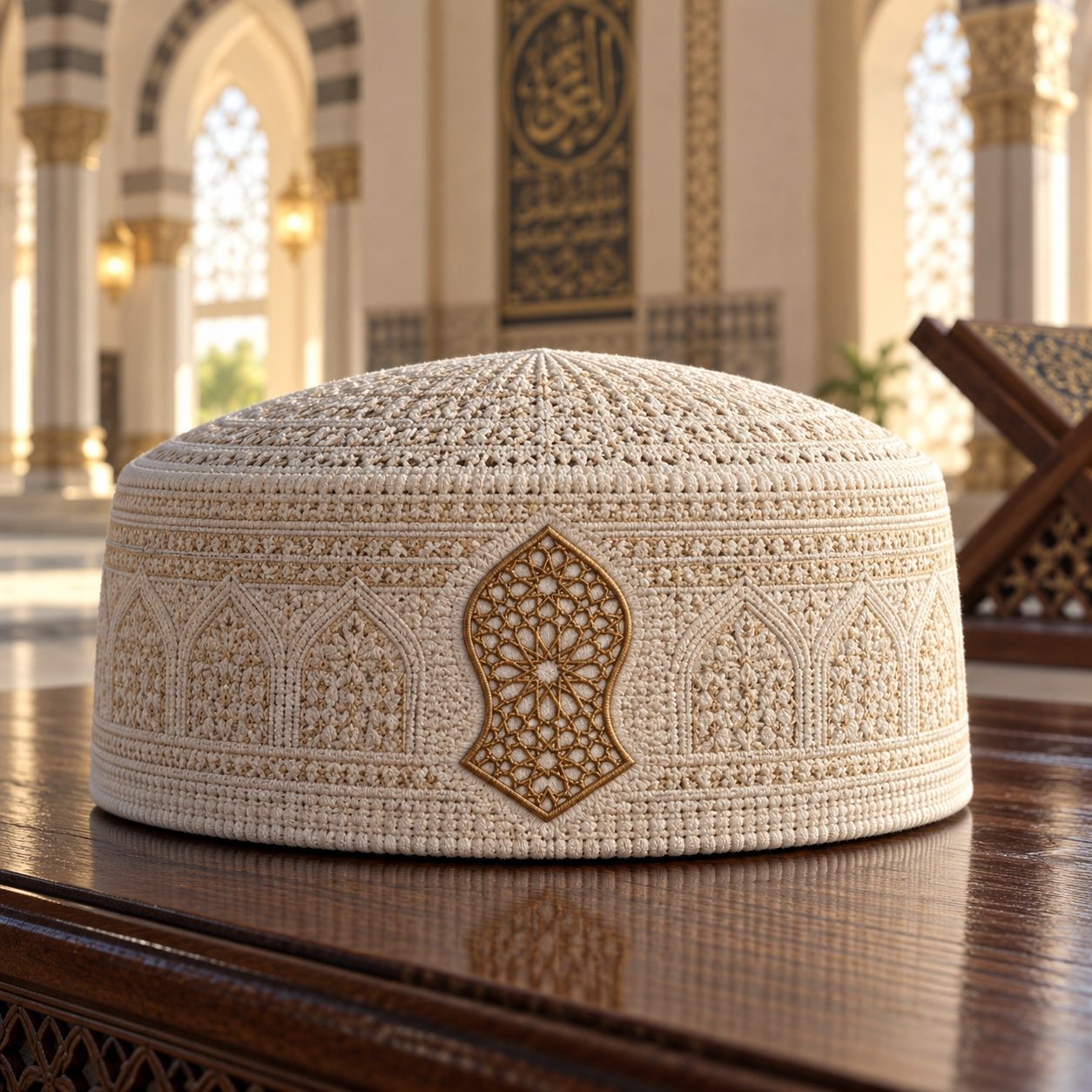
There are some symbols in Muslim culture that immediately bring a sense of love and reverence. The Nalain Shareef, the traditional representation of the blessed sandals of the Prophet Muhammad ﷺ, is one of them.
You may have seen the familiar sandal-shaped design embroidered onto a kufi, cap, or other Islamic garment. For many Muslims, seeing the symbol brings to mind the Prophet ﷺ, his simple way of life, and the deep love Muslims have carried for him across generations.
But where does the design come from? What do the hadith actually tell us about the Prophet’s sandals? And why has this particular image become such a recognizable part of Islamic art and clothing?
What Is the Nalain Shareef?
The Arabic word na’l refers to a sandal or similar footwear, while nalain is commonly used in South Asian and other Muslim traditions for a pair of sandals. The addition of Shareef expresses honor and respect.
When Muslims speak of the Nalain Shareef, they are referring to the sandals associated with the Prophet Muhammad ﷺ. The familiar emblem is a visual representation of those sandals, based on descriptions preserved in the hadith.
This is one of those small physical details from the life of the Prophet ﷺ that the early Muslims took care to preserve. Alongside descriptions of his clothing, appearance, manner, and daily habits, the hadith also record details about his footwear.
What Did the Prophet’s Sandals Look Like?
One of the clearest descriptions comes from Anas ibn Malik رضي الله عنه, a close Companion of the Prophet ﷺ.
In Sahih al-Bukhari 5857, Anas رضي الله عنه reported that the sandal of the Prophet ﷺ had two straps. Another narration records Anas bringing out a pair of sandals with two straps, which Thabit al-Bunani identified as the sandals of the Prophet ﷺ.
The same basic description appears in Jami’ al-Tirmidhi. Anas رضي الله عنه was asked what the sandals of the Messenger of Allah ﷺ were like, and he answered that they had two straps. Imam al-Tirmidhi described the narration as Hasan Sahih. Jami’ al-Tirmidhi 1772.
This simple description is the foundation for the familiar two-strap sandal form seen in Nalain Shareef artwork.
Why Is the Nalain Shareef Used as a Symbol?
Muslim love for the Prophet ﷺ has always found expression in many beautiful forms.
Throughout Muslim history, people have written poetry in his praise, composed calligraphy containing his name and blessings upon him, preserved descriptions of his appearance and belongings, and created artwork inspired by aspects of his blessed life.
The Nalain Shareef belongs to this wider tradition of remembering the Messenger of Allah ﷺ.
There is something especially touching about the symbol itself. It is not a portrait. Instead, it represents something very simple and personal: the sandals worn by the Prophet ﷺ as he walked among his Companions, visited his community, traveled, worshipped Allah, and carried out the responsibilities of his Prophethood.
For many Muslims, that simplicity is part of the beauty of the symbol.
A Small Object Connected to a Beloved Messenger
The Companions رضي الله عنهم paid close attention to the life of the Prophet ﷺ. Details that might seem ordinary to us could be precious to them because they belonged to the life of the Messenger of Allah.
Anas ibn Malik رضي الله عنه spent years in the company of the Prophet ﷺ and transmitted many details about his life. The fact that descriptions of the Prophet’s sandals were preserved in multiple hadith collections gives us a glimpse into how carefully aspects of his daily life were remembered.
The Nalain emblem brings that sense of remembrance into a visual form. A small sandal-shaped design on a kufi can therefore carry a much larger meaning for the person wearing it: I remember the Messenger of Allah ﷺ.
Nalain Shareef and Islamic Headwear
Today, the Nalain Shareef design can be found on a variety of Muslim headwear. On a kufi, it may appear as embroidery, woven detail, applique, or part of a larger traditional pattern.
The design can be understated and elegant, or more prominent and decorative. Different Muslim communities have developed their own approaches to colors, fabrics, stitching, and placement, giving the symbol a distinctly local character while preserving its recognizable form.
This makes the nalain shareef kufi emblem particularly interesting. The kufi itself is a familiar form of Muslim headwear across many parts of the world, while the Nalain design adds a specific connection to the life of the Prophet ﷺ.
A Tradition of Remembering the Prophet ﷺ
The Qur’an teaches Muslims to send blessings upon the Prophet ﷺ:
“Indeed, Allah and His angels send blessings upon the Prophet. O you who believe, send blessings upon him and peace abundantly.”
Qur’an 33:56
The Muslim relationship with the Prophet ﷺ is therefore not merely historical. His life remains an example for believers, and remembering him is naturally woven into Muslim worship and daily life.
A Nalain emblem does not need to be complicated to be meaningful. For someone who wears it, it can simply be a visual reminder of salawat, love for the Messenger ﷺ, and the desire to follow his beautiful example.
Preserving the Memory of the Prophet’s Relics
The interest Muslims have shown in objects associated with the Prophet ﷺ extends beyond his sandals. Historical Muslim communities have also preserved and documented objects believed to have belonged to him, including clothing, letters, vessels, and other personal items.
For an introduction to the broader historical subject, see this overview of relics associated with the Prophet Muhammad ﷺ.
The Nalain Shareef is especially distinctive because descriptions of the Prophet’s sandals are preserved directly in well-known hadith. The reports from Anas رضي الله عنه give us a simple but memorable picture: a pair of sandals with two straps.
A Meaningful Design for Everyday Wear
That is part of what makes the Nalain Shareef such a beautiful design for a kufi. It connects an everyday piece of clothing with remembrance of the Prophet ﷺ without needing elaborate decoration.
Whether worn for Jumu’ah, at the masjid, during a gathering, at home, or simply as part of everyday Muslim dress, a kufi carrying the emblem can be a quiet expression of love and connection.
If you appreciate this traditional design, you can explore kufi hats featuring the Prophet’s sandal emblem. Different styles allow the Nalain design to be incorporated into both traditional and contemporary Muslim headwear.
Remembering the Messenger ﷺ
The Nalain Shareef is a small symbol with a meaningful story behind it. Authentic hadith preserve the description of the Prophet Muhammad’s ﷺ sandals, including their two straps. Muslim tradition has carried that description forward and transformed it into a recognizable emblem of remembrance and love.
For generations of Muslims, the image of the blessed sandals has been more than an artistic design. It is a reminder of the person who brought the message of Islam, taught the Qur’an, showed mercy to his community, and gave Muslims an example to follow.
And perhaps that is the simplest way to appreciate a Nalain Shareef kufi: not merely as something embroidered onto a cap, but as a small reminder to keep the Messenger of Allah ﷺ close in our hearts and to let our love for him inspire us to live by his example.

Comments